

Home > Battery Recycling & Disposal
Lithium ion Battery Recycling & Safe Disposal
Safe . Compliant . Sustainable
Lithium batteries are widely used in medical, robotics, industrial, security, and outdoor equipment.
Proper end-of-life handling is essential for safety, regulatory compliance, and environmental protection.
With 23 years of experience in custom lithium batteries, LARGE provides not only compliant battery systems, but also professional guidance for safe recycling and disposal, supporting sustainable operations worldwide.
Why must lithium batteries be recycled properly?
Lithium batteries contain active materials and electrolytes.
Improper disposal may cause:
- Fire, short circuits, or chemical leakage
- Environmental contamination
- Regulatory violations (often classified as hazardous waste)
At the same time, end-of-life batteries contain valuable recyclable materials such as copper, aluminum, nickel, cobalt, and lithium. Proper recycling reduces risk and supports resource recovery.
LARGE’s Environmental Responsibility
As a professional lithium battery manufacturer, LARGE upholds environmental and safety responsibilities throughout the entire product lifecycle:
Material Transparency
Providing necessary
material and
chemistry information
Recycling-Friendly Design
Improving disassembly
and material recovery
Standards Compliance
RoHS, REACH, IEC 62133
Lifecycle Impact Reduction
High efficiency and long service life
Guidelines for the proper disposal of used lithium batteries
Whether it’s the battery cell, battery pack, or built-in battery of a device, it is recommended to follow the following principles: LARGE can provide regional recycling references upon request.
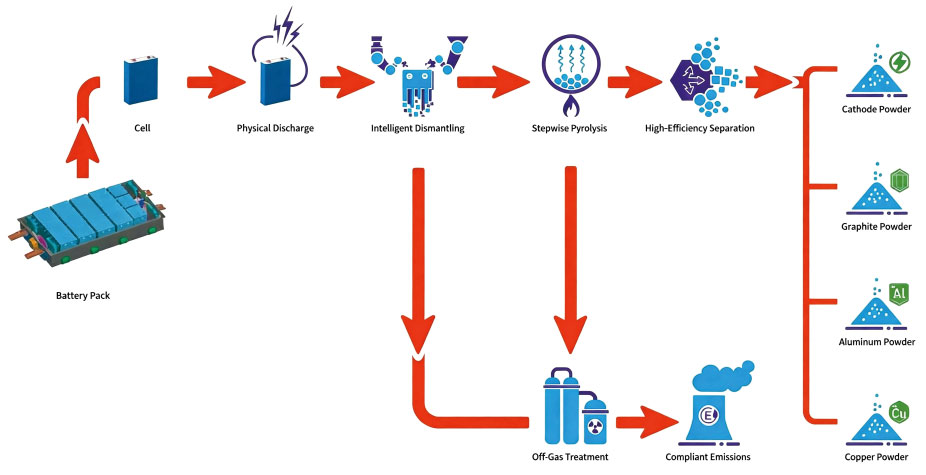
Feasible disposal methods for scrapped batteries
Performed by Certified Organizations Only
- Disassembly and recycling
Separation of casing, conductor, and PCB;
- Material regeneration
Extraction and reuse of Cu, Al, Ni, Co, Li etc.
- Cascade utilization evaluation
Applicable to batteries with decreased capacity but still possessing safety.
How LARGE Can Support You
When batteries reach the retirement or disposal stage, we provide practical technical and
compliance support:
Battery material and chemistry information
Assist recycling organizations in evaluating chemical compositions, disposal methods and potential hazards.
Packaging and temporary storage guidance
Covers UN3480/3481 classification, short-circuit protection measures, temporary packaging guidelines, etc.
Battery Storage Guidelines
Provide guidelines on charge level, safe environment, short-circuit prevention and periodic inspection to ensure pre-recycling safety & compliance.
Environmental Compliance Documentation
Provide a full set of environmental compliance documents such as Material Declaration, chemical composition list and environmental compliance certificates.
Regional Environmental Guidelines
Provide references to local authorized recycling organizations and environmental authorities based on the customer’s country or region.
FAQ
Where can lithium-ion batteries be recycled?
- Local hazardous waste collection centers
- Certified battery recycling companies
- Electronics retailers or service centers
- Community-designated battery collection points
Can lithium-ion batteries be recycled?
Yes. Materials such as nickel, cobalt, lithium, copper, and aluminum can be recovered through certified recycling processes.
How should lithium batteries be recycled?
Follow these steps:
·Keep the battery intact (do not crush or puncture)
·Insulate terminals to prevent short circuits
·Use fire-resistant, shock-protective packaging
·Deliver to an authorized recycling facility
·Do not dismantle batteries yourself.
How can I find lithium battery recycling near me?
You may:
·Search for “battery recycling” or “hazardous waste” on map services
·Contact local environmental authorities
·Visit community waste collection centers
·Use manufacturer or brand take-back programs
How can lithium batteries be disposed of safely?
Do not dispose of with household waste
·Insulate terminals to prevent short circuits
·Package separately using fire-resistant materials
·Avoid crushing, dropping, or water exposure
·Hand over to licensed recycling organizations
Can end-of-life batteries be returned to LARGE for recycling?
No. LARGE is not a recycling operator, but can provide technical guidance and regional recycling references.
Can discarded batteries be reused for energy storage?
Only after evaluating capacity, safety, and internal resistance. LARGE may assist with technical assessment but does not provide repurposing services.
Are waste lithium batteries classified as hazardous waste?
In most regions, yes. They must be handled by licensed hazardous waste processors.
Is UN38.3 required for transporting waste batteries?
UN38.3 applies to commercial product transport. Waste batteries must follow local hazardous waste transport regulations.
Can LARGE recommend recycling partners?
Yes, regional reference information can be provided upon request. LARGE does not assume responsibility for recycling or transport.
Request Your Custom Lithium Battery Pack Evaluation
Weíll provide a tailored evaluation covering cell design, BMS strategy, structure, thermal management and safety engineering.